

Maternity Care Unbundling
On January 1, 2027, the AMA is set to retire global maternity codes and separate billable events into antepartum, labor management, delivery and postpartum reporting. 17 codes will be deleted, 12 added, and 6 revised.
From Global Billing to Discrete Encounters
The Global OB Package is Ending
Personalized care has evolved as the standard for pregnancy and postpartum, while global OB billing codes do not account for the additional touch points and care delivered by providers. On January 1, 2027, global OB CPT codes will be retired in favor of transitioning to billing for tailored care with unbundled, granular E/M & discrete CPTs. Unbundling will include itemized billing for Antepartum E/M, RPM, Dedicated Labor Management, Extended Postpartum & Laceration/Procedure codes.
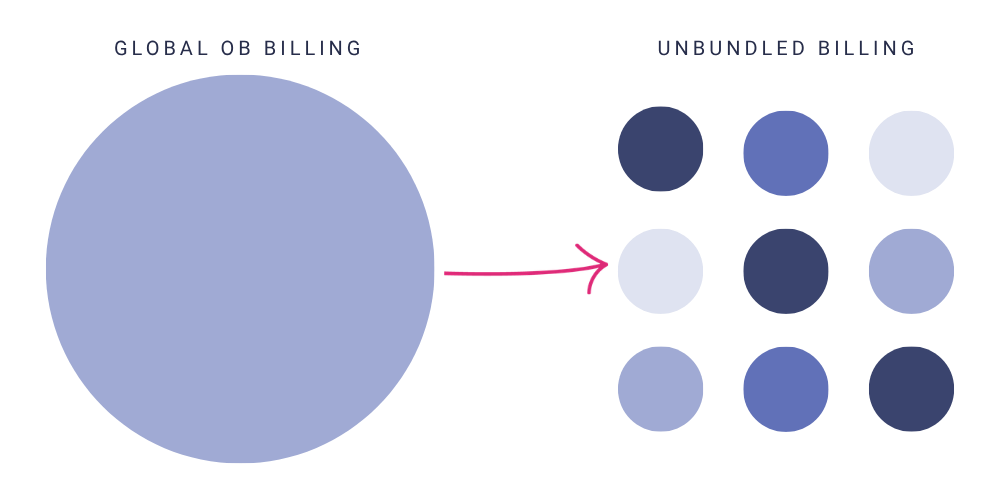
Impacts of billing changes
Practices and health systems need to update documentation, EHR templates, charge capture, and billing workflows. Each visit must be documented well enough to support its own code. Payers must update fee schedules, claim edits, and contracts, and they're doing it on different timelines. Finally, Patients may see cost-sharing on individual visits rather than one package, which can raise benefit and cost questions.Operationalizing Tailored Care
Babyscripts & Unbundling
Babyscripts can help maternity providers operationalize tailored care, identify medically necessary encounters, document delivered services and capture revenue that was previously obscured inside the global maternity package.
RPM with Low- & High-Risk Pathways
Tailor prenatal schedules with precise trigger protocols that validate additional E/M encounters for hypertensive or gestational diabetes patients.
Capture blood pressure readings and weight monitoring as billable discrete encounters (CPT 99453, 99454, 99457).
EHR Workflows & Auditable Documentation
Seamless EHR workflows for required medical necessity justification and codes. Reporting with summaries and transcripts of patient interactions and messaging required for time-based E/M billing.
Unbundling News
- AMA transition guidance states that care delivered in 2026 follows 2026 rules, and encounters on or after January 1, 2027 use the new service-level codes. For patients due in 2027, AMA advises documenting each visit's complexity or time now. Learn more here.

9/25/2026: The State of Maternity Care and Digital Health
The comment period around CMS’ proposed rule with changes to obstetric billing and remote patient monitoring requirements ended on September 14, 2026. A final decision is expected on November 1, 2026.

Intersecting Challenges in Maternity Care: Proposed CMS RPM Changes, OB Code Unbundling, RHTP & TMaH
Proposed CMS RPM changes add complexity to a massive overhaul of obstetric billing (unbundling), alongside intersecting challenges of RHTP and TMaH.
Unbundling by Payer
Although new codes exist to cover distinct parts of pregnancy and postpartum, coverage varies by payer.
Last updated October 21, 2026.
Payer |
Global Codes Retiring January 1, 2027? |
Separate Codes |
Transition Guidance |
| Aetna | Yes |
TBD |
TBD |
| Amerihealth Caritas Next (LA) | Yes |
TBD |
TBD |
| Blue Shield CA | Yes |
✔️Antepartum ✔️Labor Management ✔️Delivery ✔️Postpartum |
|
| BCBS Nebraska | TBD |
TBD |
TBD |
| Blue KC | Yes |
TBD |
E/M billing from Sept 1 for patients expected to deliver on or after Jan 1, 2027. |
| Capital Blue Cross | Yes | TBD | E/M + TH modifier for certain new antepartum patients from Sept 1; TH on all maternity codes from Nov 1. |
| Cigna | TBD | TBD | TBD |
| Highmark | Yes | For members due January 1, 2027 or later, transition begins with E/M + TH. | Link |
| Jefferson Health Plans | Yes | TBD | Effective Nov 1, it will no longer accept global maternity codes for new pregnancies; further guidance is promised. Link |
| Premera | Yes | TBD | TBD |
| Select Health | Yes | TBD | Current codes through Dec 31, then E/M + TH. |
| Sentara | Yes | TBD | Use antepartum codes now for 2026 pregnancies delivering after Jan 1. |
| State Medicaid (AL, MA, ME, MI, MN, NC, NY, VA) | Yes | TBD |
Timelines range from June 2026 early transition to holding through Dec 31.
|